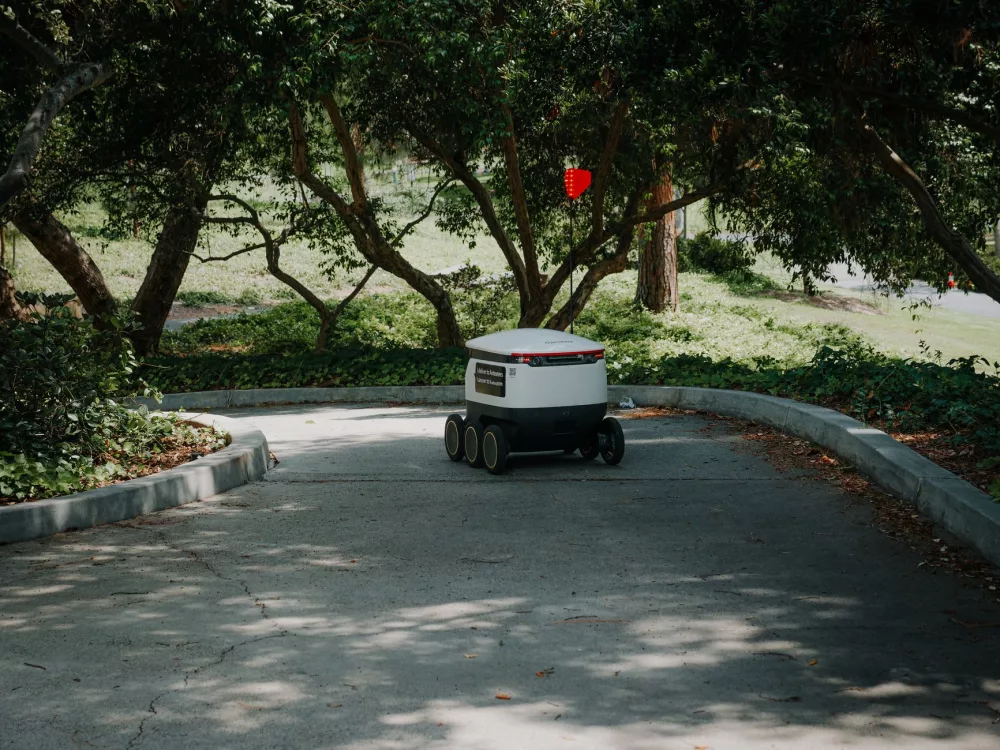
Alright, let's talk about Nuro. When I first heard about fully autonomous delivery robots zipping around neighborhoods, I admit I was a little skeptical, maybe even a little intrigued. But after digging into what Nuro is doing, I'm genuinely impressed. This company isn't just building cool gadgets; they're actually rethinking the entire last-mile delivery system, and that's a big deal. For me, Nuro represents one of the most practical and immediate applications of self-driving technology we're seeing today.
What Exactly Is Nuro and Why Should We Care?
At its heart, Nuro is an autonomous vehicle company focusing specifically on goods delivery, not people transport. Think about that for a second. Most of the buzz around self-driving cars centers on ride-hailing or personal ownership. Nuro, however, saw a massive opportunity in getting your groceries, your pizza, or your prescriptions from point A to point B without a human driver. It's a distinct niche, and I think it's a smart one because it sidesteps a lot of the trickier ethical and safety questions associated with human passengers, at least initially.
They've essentially designed a vehicle from the ground up for this purpose, which is called the R2. It’s not just a regular car with some sensors slapped on; it’s purpose-built. You won't find steering wheels, pedals, or even seats for people in an R2. That design choice alone tells you a lot about their focused mission. I mean, how cool is that? They've completely optimized for cargo, and that allows for some really interesting safety and efficiency benefits.
The R2: A Closer Look at Nuro's Delivery Robot
The Nuro R2 vehicle itself is quite distinctive. It's smaller than a typical car, rounded, and looks a bit futuristic, almost friendly. This isn't by accident. Its compact size helps it navigate urban and suburban streets more easily, and its gentle appearance might just make it more acceptable to the public. I believe this kind of thoughtful design really matters for public adoption.
- Driverless Design: As I mentioned, no space for a human driver. This means the interior can be completely repurposed for cargo compartments.
- Temperature Control: Crucially, these compartments can be temperature-controlled, which is essential for delivering things like groceries, hot food, or even sensitive medications.
- Safety First: The R2 is designed with safety as a top priority. It's got a softer, more deformable exterior than a regular car, which could reduce harm in the unlikely event of an impact with a pedestrian or cyclist. Plus, because there's no human inside, there's no human life at stake in the vehicle itself.
When you see one of these things driving around, you can't help but notice how it's integrated with advanced sensor technology. We're talking about an array of cameras, radar, lidar, and ultrasonic sensors that allow it to perceive its environment in 360 degrees. It's essentially got eyes everywhere, feeding data into its onboard AI to navigate, avoid obstacles, and understand traffic laws. It's pretty sophisticated stuff, if you ask me.
How Nuro's Technology Works Its Magic
So, how does this thing actually know where it's going and how to get there safely? It's a combination of cutting-edge robotics, artificial intelligence, and extensive mapping. I always tell people that autonomous driving isn't just about sensors; it's about making sense of the world, and Nuro's system is built to do just that.
Sophisticated Sensing and AI
The R2 uses a multi-modal sensor suite, which means it combines data from different types of sensors. Why is this important? Well, radar works great in bad weather like rain or fog where cameras might struggle. Lidar provides incredibly precise 3D mapping of the environment, even at night. Cameras, on the other hand, are excellent for identifying traffic lights, signs, and distinguishing between different types of objects. By fusing all this data, Nuro's AI creates a robust, real-time understanding of its surroundings. It's like having multiple pairs of eyes that complement each other's strengths and weaknesses.
This data then feeds into an AI system that's been trained on millions of miles of simulated and real-world driving. It predicts the behavior of other road users, plans its route, and makes decisions in fractions of a second. The level of redundancy and verification built into their software is really quite impressive, all aimed at ensuring maximum safety on the road. I've read quite a bit about their safety protocols, and they seem incredibly thorough, prioritizing the safety of everyone around the vehicle.
Real-World Impact: Partnerships and Practical Use Cases
What I find particularly exciting about Nuro isn't just the tech, but its practical application. They haven't just built a prototype; they've deployed it in actual communities, delivering real goods to real people. They’ve inked some seriously significant partnerships, showing that major players in various industries see the value in this technology.
- Grocery Delivery with Kroger: Nuro has partnered with Kroger, one of the largest grocery retailers in the U.S., to deliver groceries to customers. This means fresher food, delivered efficiently right to your door.
- Pharmacy Solutions with CVS: Imagine getting your prescriptions delivered autonomously. Nuro has worked with CVS to make this a reality in some areas, offering a convenient and contact-free option.
- Pizza Delivery with Domino's: Yes, even pizza! Partnering with Domino's means a hot pie can arrive at your doorstep, delivered by an R2. I can see why this would appeal to folks looking for quick, hassle-free delivery.
- Parcel Delivery with FedEx: They've even explored working with FedEx for package delivery. This could revolutionize how small parcels are handled in urban environments.
These partnerships highlight the versatility of Nuro's platform. It's not just for one type of item; it's for anything that needs to be moved from a store or distribution center to a consumer. I think this broad applicability is a huge reason for their potential success.
The Benefits We Can All Look Forward To
When you step back, the advantages of autonomous last-mile delivery, especially through a system like Nuro's, become pretty clear. It's not just a novelty; it addresses some genuine pain points in modern life.
One major benefit is efficiency and convenience. Think about how much time people spend driving for deliveries. Automating this frees up human labor for other tasks, and it can potentially lead to faster, more reliable delivery windows. I know I'd appreciate less waiting around for a package.
Then there's the potential for reduced traffic congestion and emissions. If more deliveries are handled by purpose-built electric autonomous vehicles, that means fewer human-driven cars on the road, fewer idling vehicles, and a smaller carbon footprint. That's a win for urban planning and environmental goals, in my opinion.
Also, let's not forget about safety. While no technology is 100% foolproof, autonomous systems don't get distracted, drowsy, or drive under the influence. With rigorous testing and continuous improvement, these vehicles could significantly reduce the number of accidents caused by human error in delivery operations. The R2's specific design, as I mentioned, also inherently prioritizes the safety of those outside the vehicle.
Challenges and the Road Ahead
Of course, it's not all sunshine and smooth roads for Nuro. There are significant hurdles they, and the autonomous vehicle industry in general, need to overcome. Regulatory landscapes vary widely from state to state and even city to city, creating a patchwork of rules that can be tough to navigate. Getting widespread approval takes time and effort.
Then there's the issue of public acceptance. While I think many people are open to the idea, some still harbor skepticism or even fear about driverless vehicles. Building trust through reliable and safe operation is absolutely crucial. Also, scaling production to meet demand and keeping the costs down will be a massive undertaking. They've got to build a lot of these robots!
Despite these challenges, I really do feel Nuro is well-positioned for the future. Their focused approach to goods delivery makes a lot of sense, allowing them to iterate and improve without the added complexity of human passengers. As technology advances and regulations hopefully become more standardized, I expect to see these friendly little robots become an increasingly common sight in our neighborhoods. It's an exciting time to watch this space evolve, and Nuro is definitely one to keep an eye on.